


Lasik & vision correction
Lasik & vision correction
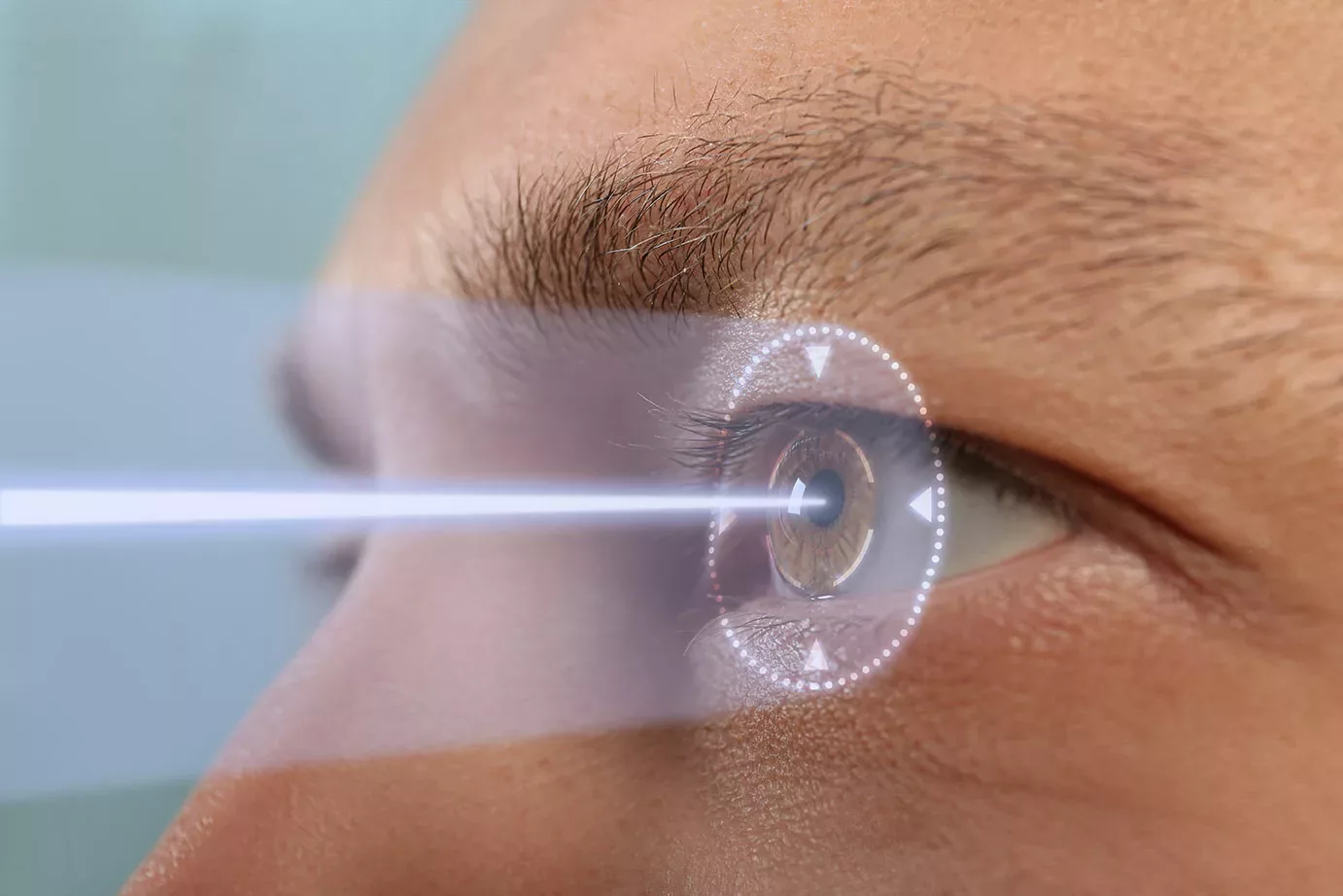
Get ready to say goodbye to glasses and contact lenses with the latest LASIK technologies for
vision correction and getting rid of glasses and lenses in safe and effective ways.
What is Refractive Surgery ?
Refractive eye surgeries are precise medical procedures designed to correct vision problems such as myopia (nearsightedness), hyperopia (farsightedness), and astigmatism.
They aim to improve visual clarity and reduce or eliminate the need for glasses or contact lenses.
Types of Refractive Surgeries :
1. PRK (Photorefractive Keratectomy)
-
One of the earliest laser vision correction techniques.
-
The surface layer of the cornea is removed, and the inner layers are reshaped with an excimer laser.
-
A protective contact lens is used temporarily during healing.
-
Pros: High success rate (~95%), safe, fewer complications.
-
Cons: Longer healing time and more discomfort compared to LASIK.
2. LASIK (Laser-Assisted In Situ Keratomileusis)
-
The most common refractive procedure worldwide.
-
A corneal flap is created and lifted, then the corneal tissue is reshaped with a laser.
-
Pros: Fast recovery, excellent results.
-
Cons: May cause dry eyes, halos, or glare at night.
3. Femto-LASIK
-
A more advanced technique using a femtosecond laser to create a very thin and precise corneal flap.
-
Safer and more accurate than conventional LASIK.
-
Suitable for patients with thinner corneas.
-
Cons: Higher cost, limited long-term effectiveness in certain cases.
4. SMILE (Small Incision Lenticule Extraction)
-
One of the latest techniques.
-
Does not require a corneal flap; a small incision is made, and a lenticule is removed with a femtosecond laser.
-
Pros: Less invasive, lower risk of dry eye, quick recovery.
-
Cons: Mainly treats myopia up to -8D, less effective for severe prescriptions.
Pre-Operative Examinations :
-
Visual acuity test.
-
Corneal topography.
-
Intraocular pressure measurement.
-
Corneal thickness measurement.
Who is a Candidate ?
-
Patients over 18 years old.
-
Stable vision prescription for at least one year.
-
No corneal diseases (e.g., keratoconus).
-
No uncontrolled systemic conditions (e.g., diabetes, autoimmune diseases).
⚠️ After age 40, patients may still require reading glasses due to presbyopia, even after surgery.
: Post-surgery Care
• Use prescribed eye drops regularly.
• Avoid rubbing the eyes.
• Avoid swimming or exposure to dust and smoke for at least two weeks.
• Wear protective sunglasses when outdoors.
• Attend follow-up visits to check the stability of the results.
Advantages of LASIK
• Fast procedure and quick recovery.
• High success rates.
• Freedom from glasses and lenses.
• Improved quality of life and visual clarity.
Our Technologies
1 — Femtosecond Laser (Femto-LASIK)
An advanced technique that uses a femtosecond laser instead of a surgical blade to create the flap, offering higher precision and greater safety.
2 — Contoura Vision
A very modern technique that treats the cornea based on its personalized topographic map, providing higher visual accuracy and better optical quality.
3 — Implantable Collamer Lens (ICL)
For individuals who are not eligible for LASIK due to severe nearsightedness or thin corneas, a special lens is implanted inside the eye without removing the natural lens.
Patient Success Stories
Hear directly from our patients about their transformative experiences with Dr. Swaid and our dedicated team